See how fuel, water recovery and fuel cells work together inside the POWER POD.
How the POWER POD works
The POWER POD reforms a hydrogen carrier on-site, then feeds the hydrogen to a fuel cell to generate electricity.
Hydrogen carrier
LPG or another supported fuel.
Reformer
Reacts the fuel with steam to release hydrogen.
Hydrogen
A hydrogen-rich gas flows to the fuel cell.
Fuel cell
Hydrogen reacts with oxygen from the air.
Electricity
Powers a load or charges batteries.
Steam feeds the reformer.Recovered water is reused within the system.
Hydrogen from LPG + steam
One LPG cylinder. Around 30 hydrogen cylinders.*
Using steam reforming, a 48 kg LPG fill produces approximately 21.85 kg of hydrogen on the calculation basis below.
1 × 48 kg LPG cylinder≈30 hydrogen cylinders*
48 kg LPG fill≈21.85 kg H₂ produced* Typical height ≈1.3 m
SIZE GUIDE
≈
50 L · 200 bar · each≈0.74 kg of hydrogen per cylinder Typical height ≈1.6 m
Carry the fuel. Produce hydrogen on-site.*When using steam reforming: 0.4552 kg of H₂ per kg of LPG.Quantity illustration not to scale. The small size guide uses a common height scale.
The POWER POD reforms the hydrogen carrier with steam to produce hydrogen for the fuel cell. This comparison includes hydrogen contributed by the steam, rather than only the hydrogen chemically bound in the LPG.
Example calculation & cylinder reference
HYENA’s supplied steam-reforming basis: 0.4552 kg of hydrogen per kg of LPG. A 48 kg fuel fill × 0.4552 = 21.8496 kg of hydrogen, rounded to 21.85 kg.
Hydrogen cylinder example: 50 litres at 200 bar, with approximately 0.74 kg of hydrogen per cylinder. 21.8496 ÷ 0.74 = 29.53 cylinders, rounded to about 30.
The cylinder reference uses a supplier-listed gas content of 8.8 m³ at 15°C and 1 bar, converted at approximately 0.084 kg/m³. Cylinder counts vary with size and filling pressure. This is a hydrogen-quantity calculation, not a comparison of electrical output or runtime.
The use of existing LPG infrastructure makes HYENA’s POWER POD deployable now.
This is a huge advantage over our competitors using non-distributed fuels, such as methanol or ammonia, specifically in developing countries.
POWER POD advantages
How POWER POD compares with other power technologies.
Compared with
Renewable energy
Solar, wind and batteries
Continuous operation
Weather-independent
Compared with
Diesel generators
Silent operation
Significantly extended service intervals
No diesel/oil spillage
Low probability of fuel theft
Compared with
Other fuel cell systems
LPG, propane, natural gas, or biomethane (existing infrastructure)
In-field service/cartridge replacement
Recyclable PGM-based catalysts
Designed to power telecom towers
Research & development
Developed and tested in-house.
HYENA’s laboratory brings development and testing together in one facility, with a full extraction system and a range of gases available for experimental work. It gives our team a practical environment to develop, test and refine hydrogen and fuel cell systems.
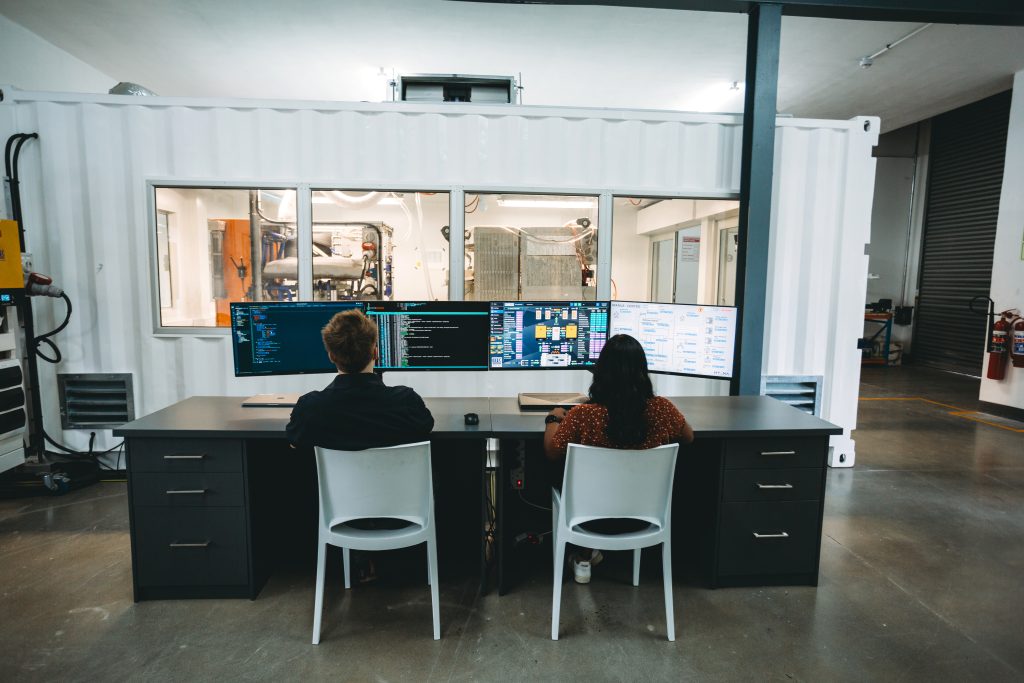
Hands-on development and testing inside the HYENA laboratory.Monitoring and controls alongside the development and test area.
Purpose-built test space
A dedicated laboratory with extraction for development and experimental testing.
A range of test gases
Access to multiple gases supports testing across different development requirements.
Engineering under one roof
Hands-on development, instrumentation and controls help the team test ideas and refine system operation.
The development journey
From the test bench to the POWER POD.
Laboratory development. Enclosed systems. POWER POD PIONEER SERIES.
Stage 01
Laboratory development
Laboratory system development and testing.
Stage 02
Enclosed development units
Enclosed units, refined through laboratory testing.
Stage 03
POWER POD PIONEER SERIES
Latest POWER POD PIONEER SERIES configuration.
Looking ahead
A pathway to lower-carbon fuels.
Fuel flexibility creates opportunities to use lower-carbon alternatives as their supply develops.
LPG contains carbon. It can also be produced synthetically using captured CO2 and renewable hydrogen—an approach known as power-to-X. These “green gas” pathways offer a route to reducing the carbon footprint of fuels supplied through existing infrastructure.